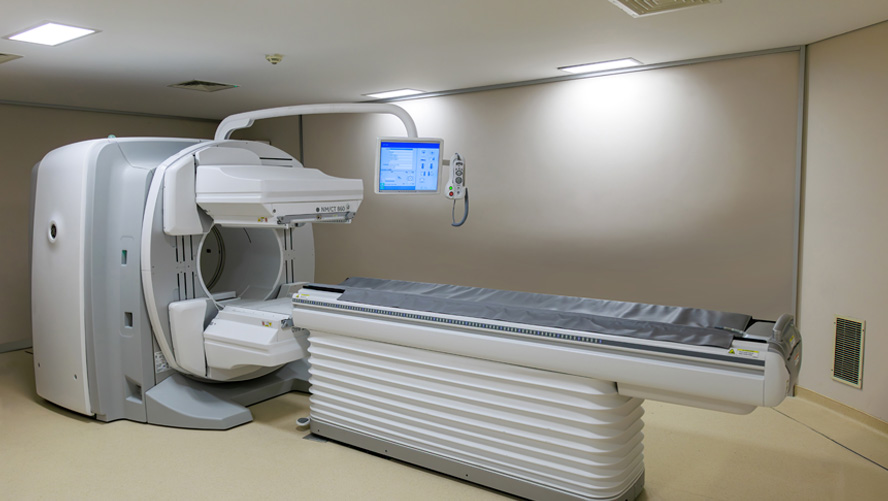
Our hospital utilizes a new generation SPECT/CT device designed to optimize routine clinical workflows with digital capabilities and increase quantitative efficiency in hybrid imaging. High-resolution and high-sensitivity collimators reduce imaging time and enhance patient comfort without compromising image quality. This system offers a balanced solution for departments like ours that require managing high patient volumes and obtaining quantitative SPECT results in core areas of nuclear medicine such as cardiology and oncology.
What is SPECT/CT and how does it work?
SPECT/CT is a hybrid device that combines two powerful imaging methods. It works by combining biological molecules targeting the desired organ with a radioactive substance in a laboratory setting, and then administering this combination to the patient. This results in imaging that reflects physiological processes. Because it is a physiological imaging method that allows us to evaluate organ function and even make numerical assessments, it makes a significant contribution to the diagnosis and treatment of the patient.
What can be done with SPECT/CT?
- All scintigraphic imaging techniques are combined with CT to provide both anatomical and functional imaging. Furthermore, in myocardial perfusion scintigraphy, frequently used in cardiology, high-quality imaging based on detector technology, along with attenuation correction, segmentation, scoring, and quantitative assessment of ischemia-scar tissue area using CT, are performed with high accuracy.
- In the field of oncology, dosimetric studies, which allow us to determine the dose of treatment to be applied before therapy, especially in Y-90 Microsphere Therapy (TARE) planning, provide fast and reliable results in liver volume-target tumor area and lung shunt calculations with an artificial intelligence-supported interface.
- In addition, in cases of essential tremor, a neurological disorder manifesting as hand tremors, our experienced team performs an advanced neuroimaging method, DaTscan (Ioflupane I-123), to differentiate it from Parkinson's syndromes.
- In the field of oncology, particularly in Y-90 microsphere therapy planning, AI-powered interfaces provide fast and reliable results in liver volume-target tumor area and lung shunt calculations.
- DaTscan (Ioflupane I-123) is an advanced neuroimaging method used in nuclear medicine, particularly to differentiate Parkinson's syndromes from other causes of tremor. The I-123 Ioflupane radiopharmaceutical, injected into the patient, binds to dopamine transporters at the terminals of these neurons.
What are the advantages of SPECT/CT?
SPECT/CT, by combining anatomical and physiological imaging, makes a significant difference in terms of time and image quality, while its artificial intelligence interfaces provide important information for quantitative evaluation of images. Furthermore, its technical features and wide imaging field reduce potential claustrophobic reactions. As a physiological imaging method that allows us to evaluate organ function along with anatomical imaging, it makes a significant contribution to the accurate diagnosis of disease and the selection of appropriate treatment.
 Make an Appointment
 E-Result
 Let Us Call You